
If you take a quiet, deliberate stroll along the lush, winding pathways of The Retreat at Ngorongoro, you will quickly realize that our gardens are alive. While many safari-goers focus their eyes high in the canopy looking for bright sunbirds or soaring raptors, some of our most fascinating residents prefer to stay close to the earth.
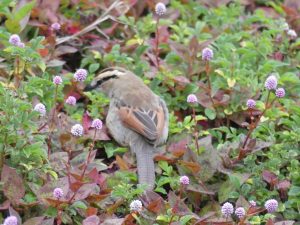
As an avid lover of nature, I am constantly scanning the flora and fauna that call our lodge grounds home. Recently, during one of my walks, I captured a beautiful moment that perfectly demonstrates nature’s camouflage at work. Nestled snugly into the colorful groundcover right at my feet was a striking Black-crowned Tchagra.
A Master Skulker in the Gardens
The Black-crowned Tchagra (Tchagra senegalus) is a member of the bushshrike family, and it is a true master of hide-and-seek. In the photo I managed to snap, you can see how its rich, warm chestnut-russet wings and long, elegant tail blend effortlessly with the earthy tones of the foliage.
Looking closely at its head, you can spot its signature features: a bold, dark crown stripe flanked by two bright white “eyebrows” (known as a supercilium). This distinct patterning isn’t just for show; it is an evolutionary design that breaks up the bird’s silhouette, making it nearly invisible to overhead predators like hawks and eagles. Tchagras are what birdwatchers call “skulkers.” Instead of flying high, they spend their days hopping deliberately through low shrubbery and thick roots, hunting for grasshoppers, beetles, and caterpillars.
Listening for the “Drunken Whistle”
While they are notoriously tricky to spot with your eyes, you will almost certainly hear them before you see them. The Black-crowned Tchagra is famous for its loud, joyful, and highly melodic descending whistle. Because the tune sounds delightfully cheerful and slightly erratic, safari guides and bird enthusiasts affectionately refer to it as the “drunken whistle.” It is one of my absolute favorite soundtracks of the East African highlands, and a frequent morning greeting for guests staying in our cottages.
The Perfect Playground: Our Pink Knotweed Blankets
The gorgeous, textured carpet this feathered friend chose for its hiding spot is Pink Knotweed (Persicaria capitata). If you wander around our landscaping, you’ll see these vibrant mats sprawling elegantly along our stone walkways and garden borders.
Characterized by its trailing stems, small oval leaves that blush into a deep plum-burgundy, and adorable, pom-pom-like clusters of tiny pink flowers, this groundcover does more than just look pretty. At The Retreat, we utilize this plant to help retain vital soil moisture, suppress weeds naturally, and create a thriving micro-ecosystem. For ground-foraging birds like the tchagra, these dense, low-lying blankets are the ultimate playground. They provide an abundant supply of small insects to feast on while offering immediate, safe cover to duck into at a moment’s notice.
Keep Your Eyes Peeled on Your Next Stay!
Moments like this remind me why the Karatu and Ngorongoro highlands are an absolute paradise for nature lovers. You don’t always need to be out on a game drive in the Crater to experience the magic of African wildlife. Sometimes, all it takes is stepping out onto your private veranda and looking down at the flowers.
On your next visit to The Retreat at Ngorongoro, grab a cup of our locally grown coffee, take a slow walk through the gardens, and listen closely for that cheerful whistle. You might just spot a master of camouflage looking right back at you!